July 05,2007
TIME:July 5, 2007
Source: IT Manager World
The journey of Dr. Lu Xianping and Chipscreen Biosciences offers a concentrated view of why innovative drug development has historically been so challenging in China.
A Defining Moment
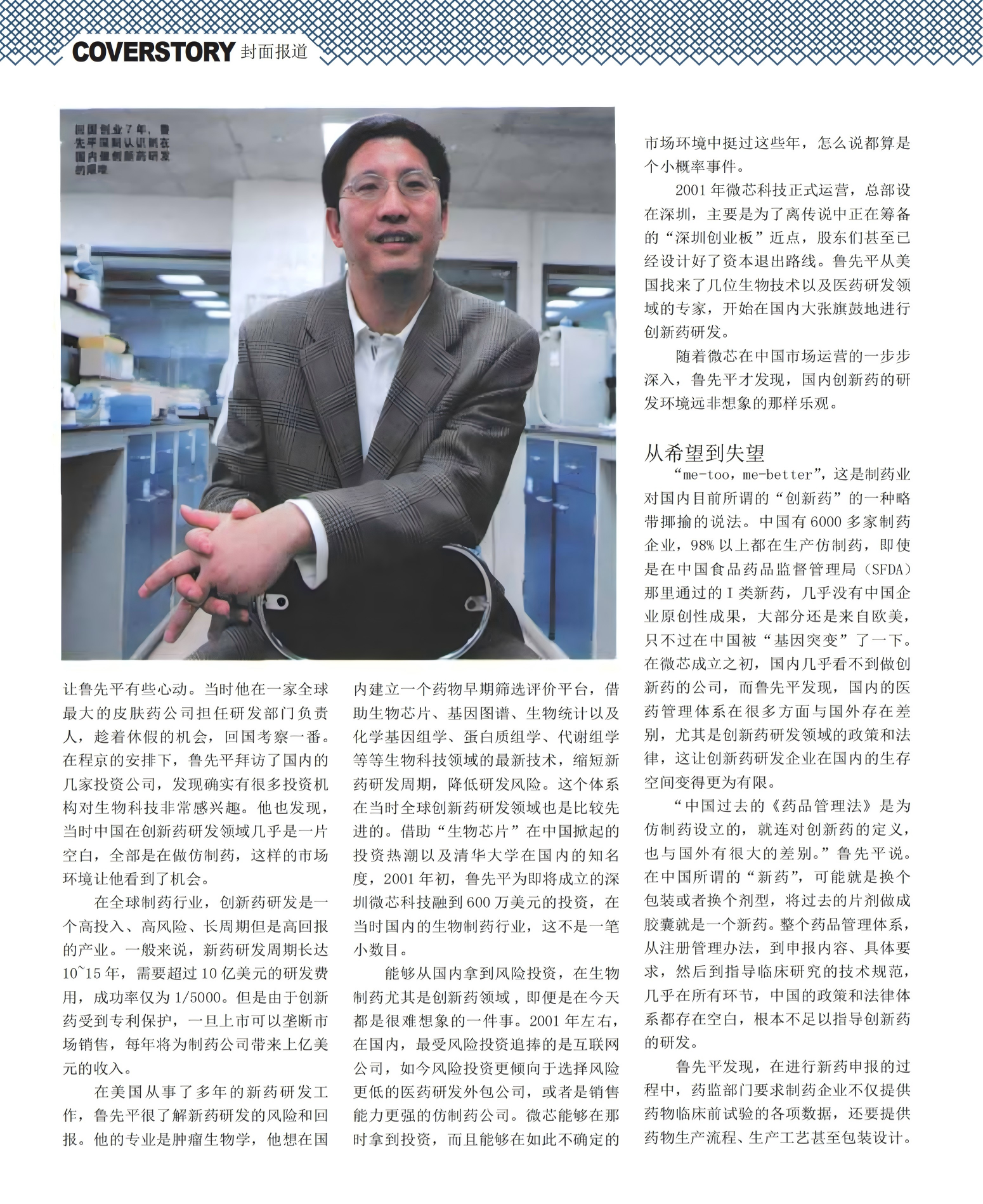
On the evening of August 29, 2000, shortly after returning to China, Dr. Lu sat in a narrow, dimly lit apartment at Tsinghua University. The aging room—cramped, sparsely furnished, and worn—stood in stark contrast to the life he had left behind in California: bright sunshine, a seaside home, and his family.
Alone under the faint light, he questioned his decision—leaving behind a stable career in the United States to start a company in China. After three hours of internal debate, he made a choice: he would stay.
More than seven years later, the company he founded—Shenzhen Chipscreen Biosciences Co., Ltd.—had grown into a flagship innovator in China’s small-molecule drug discovery sector. Its proprietary, chemistry genomics–based integrated platform for drug innovation and early evaluation represents one of the most advanced approaches in global drug R&D.
Yet that night remains vivid in his memory. What once felt like the beginning of a new chapter for China’s pharmaceutical industry now serves as a reminder of how difficult that path would become.
An Encouraging Start
In 1998, while working in the United States, Dr. Lu received a call from Dr. Cheng Jing, CEO of CapitalBio, encouraging him to return to China. At the time, China’s biotech sector was gaining momentum, fueled by strong government support and investor enthusiasm—particularly around biochip technologies.
During a visit to China, Dr. Lu met with several venture capital firms and saw clear interest in biotechnology. More importantly, he identified a critical gap: China’s pharmaceutical industry was overwhelmingly focused on generics, with little activity in original drug innovation. That gap represented opportunity.
Globally, innovative drug development is a high-risk, high-investment, long-cycle endeavor—typically requiring 10 to 15 years, over $1 billion in R&D investment, and with a success rate of roughly 1 in 5,000. However, successful drugs benefit from patent protection and can generate substantial revenues.
With a background in oncology and years of experience in the U.S., Dr. Lu set out to build an advanced early-stage drug discovery platform in China. By integrating biochips, genomics, bioinformatics, chemical genomics, proteomics, and metabolomics, he aimed to reduce development timelines and risks.
In early 2001, Chipscreen secured $6 million in venture funding—an exceptional achievement for China’s biotech sector at the time. The company officially launched in Shenzhen, assembling a team of internationally trained experts and embarking on its mission in innovative drug development.
Even by today’s standards, raising venture capital for innovative drug R&D in China remains difficult. That Chipscreen secured funding and survived in such an uncertain environment was, in many ways, a low-probability outcome.
From Optimism to Reality
As operations progressed, the challenges became clear.
At the time, more than 98% of China’s 6,000 pharmaceutical companies focused on generics. Even so-called “innovative drugs” were often incremental modifications—sometimes described within the industry as “me-too” or “me-better” drugs.
Regulatory frameworks were not designed for true innovation. China’s historical Drug Administration Law was largely built around generics, with definitions and requirements that diverged significantly from international standards. In some cases, minor formulation changes could qualify as a “new drug.”
This created structural barriers. During the drug application process, companies were required to submit not only preclinical data, but also detailed manufacturing processes and packaging designs—requirements better suited to generics than to first-in-class compounds still under development.
As a result, time saved through scientific innovation was often lost in administrative processes.
In contrast, the U.S. regulatory system allows investigational new drugs (INDs) to proceed to clinical trials within 30 days if no objections are raised. In China, approvals could take six months to a year, significantly delaying development timelines.
Meanwhile, global competitors advanced more quickly. Companies targeting similar mechanisms moved ahead in clinical development and commercialization, underscoring the competitive disadvantage.
Clinical and Commercial Challenges
Clinical development introduced another layer of complexity. Unlike generics, innovative drugs require entirely new trial designs. However, many clinicians in China had limited experience in designing such studies, requiring Chipscreen’s scientific team to take a more active role.
Commercialization posed further uncertainty. Pricing policies based primarily on manufacturing costs—rather than R&D investment—limited potential returns. At the same time, regulations required companies to build their own GMP-certified manufacturing facilities, adding significant capital burden.
Dr. Lu came to a stark conclusion: the system at the time was not structured to support innovation.
Capital Market Constraints
Chipscreen initially planned to list on Shenzhen’s anticipated Growth Enterprise Market (GEM), but delays in its launch disrupted those plans.
Unlike in the United States—where biotech companies can access capital markets at various stages—China lacked a mature financing ecosystem for innovative drug companies. By 2006, Chipscreen remained unprofitable and did not meet domestic listing requirements.
Efforts to collaborate with local pharmaceutical companies yielded limited results. Many firms preferred lower-risk business models such as generics or contract research (CRO). The absence of a standardized evaluation system for innovative drug technologies further hindered partnerships.
Turning to Global Opportunities
Facing domestic limitations, Chipscreen began looking outward.
In early 2007, the company entered into a landmark agreement with a U.S.-based partner to exclusively license international rights to its oncology drug candidate, chidamide, which had already entered Phase I clinical trials in China. The partner would be responsible for FDA regulatory submissions and clinical development in the United States.
This deal marked a milestone: Chipscreen became one of the first Chinese biotech companies to out-license an innovative drug to a U.S. partner, helping reshape global perceptions of China’s innovation capabilities.
At international conferences, Chipscreen increasingly became a reference case when discussing China’s emerging role in innovative drug R&D.
Awaiting FDA Validation
Despite this progress, uncertainties remained.
A key question was whether preclinical and clinical data generated in China would be accepted by the U.S. FDA. Differences in standards meant that some studies—such as toxicology—might need to be repeated in the United States.
At the time, chidamide had entered Phase I trials in China. Historically, only about 10% of drugs entering clinical trials ultimately reach the market. Achieving success would require years of continued effort.
For Dr. Lu, the journey of innovation was never expected to be easy—but it was necessary. And while the odds were long, the potential impact on global drug discovery made the pursuit worthwhile.
2008.12.21
2006.10.05
2006.08.21