September 30,2009
TIME:September 30, 2009
Source: JOURNAL OF CHINA PRESCRIPTION DRUG
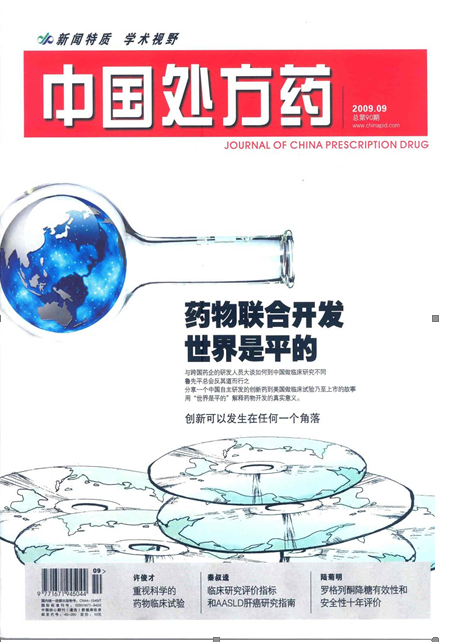
At international symposia on multi-center clinical trials, while R&D professionals from multinational pharmaceutical companies often discuss how to bring their drugs into China for clinical studies, Dr. Lu Xianping of Shenzhen Chipscreen Biosciences tends to take a different approach. He shares the story of a China-developed innovative drug advancing into U.S. clinical trials and toward commercialization—using the phrase “the world is flat” to illustrate the true meaning of global drug development.
Bridging China and the U.S.
Perhaps those who emerge from San Diego—one of the world’s leading biomedical research hubs—share common traits regardless of nationality: scientific curiosity, innovative thinking, business acumen, and a willingness to explore new paths. This may explain why Dr. Lu and Mireille Gingras quickly found common ground years later.
Dr. Lu graduated from the University of California, San Diego School of Medicine, while Gingras conducted postdoctoral research at The Scripps Research Institute—located just across the street. Their eventual meeting took place years later during a coffee break at an international drug development conference.
In October 2006, Chipscreen Biosciences signed an international patent licensing and co-development agreement with HUYA Bioscience for its novel anti-cancer drug, chidamide (HBI-8000). This marked the first time a Chinese pharmaceutical company granted a foreign partner rights to use an invention patent in innovative drug development—opening the door to joint U.S.–China development of a novel therapy.
China’s Emerging Role
When “China” and “pharmaceutical industry” appear together in Western headlines, the narrative has not always been positive. Yet two trends are undeniable.
First, China has become an increasingly important player in global biotechnology, particularly over the past five years, as policies have gradually evolved and certain regions have begun to support venture-backed innovation. Second, the U.S. pharmaceutical industry faces a growing shortage of high-quality new compounds, as development costs rise and discovery pipelines shrink.
“If countries like China and the U.S. can integrate their strengths, the potential is enormous,” said Gingras, President and CEO of HUYA Bioscience.
Over recent years, many scientists trained in top U.S. institutions have returned to China, bringing with them advanced approaches to small-molecule drug discovery and development. Gingras herself spent three years in China conducting academic visits and was deeply impressed by the capabilities of these “returnee” scientists. This experience inspired her to found HUYA Bioscience in San Diego in 2005, focusing on identifying and developing promising compounds discovered in China.
“This could be a breakthrough solution for the shrinking pipelines in the U.S.,” she noted.
A Complementary Partnership
Meanwhile, since founding Chipscreen Biosciences in 2001, Dr. Lu has led the company with a clear vision. Its proprietary integrated platform, based on chemical genomics, has become an important tool in global drug discovery. Chipscreen has come to represent China’s push toward independent innovation in pharmaceuticals.
While HUYA was seeking Chinese partners, Chipscreen—positioning itself from the outset as a global company—was also looking for opportunities beyond China.
Dr. Lu calculated that bringing a drug from Phase I to Phase III clinical trials in the U.S. would cost at least $50 million, or around $60 million including preclinical studies. “For a company like Chipscreen, independent global development is not realistic,” he said.
After unsuccessful discussions with several multinational pharmaceutical companies, Dr. Lu found HUYA’s model uniquely suited to Chipscreen’s needs: HUYA would use China-generated data to develop and commercialize the drug outside China, while Chipscreen would retain all rights within China.
Following approximately nine months of due diligence and negotiations, the two parties signed their agreement in October 2006.
“Co-development is essentially a business model,” Dr. Lu explained. “Under China’s current regulatory environment, it is a practical approach for domestic R&D organizations to bring new drugs to the global market.”
The agreement defined key elements such as patent licensing fees, milestone payments, revenue sharing, and geographic rights.
Strong Alignment in Preclinical Data
Chidamide is a novel benzamide-class histone deacetylase (HDAC) inhibitor. It was developed using computer-aided drug design and quantitative structure–activity relationship (QSAR) methods, based on published bacterial HDAC crystal structures and research on compounds such as SNDX-275 and MGCD-0103. These studies enabled predictive structural modifications, ultimately leading to the synthesis of chidamide.
Before initiating Phase I clinical trials in China in November 2007, HUYA had already secured co-development rights and supported the design of the clinical protocol. At the same time, HUYA launched preclinical studies in the United States.
HUYA leveraged a substantial portion of Chipscreen’s preclinical data generated in China for its Investigational New Drug (IND) application to the U.S. FDA. This posed challenges, as such data needed to meet GLP standards across areas including safety evaluation, pharmacokinetics (PK), pharmacodynamics (PD), toxicokinetics (TK), and CMC (chemistry, manufacturing, and controls).
Although certain toxicology studies had to be repeated in the U.S. to meet regulatory standards, the Chinese data proved highly valuable—providing key insights into pharmacokinetics, dosing, and safety. This allowed HUYA to accelerate its U.S. development efforts.
Notably, independent safety studies conducted in the U.S. produced results consistent with those from China’s Academy of Military Medical Sciences. “This demonstrates that much of China’s research is objective and reliable,” Dr. Lu said.
Advancing into Clinical Trials
The Phase I clinical trial results of chidamide generated strong interest among experts, including at the 45th Annual Meeting of the American Society of Clinical Oncology (ASCO) in Orlando.
The study evaluated safety, pharmacokinetics, biomarkers, and preliminary anti-tumor activity. Its design incorporated international best practices, including multiple dosing cohorts and dosing intervals to better understand the drug’s metabolic profile and inform Phase II dosing decisions.
According to early participants in the project, the CMC documentation submitted to the FDA was accepted on the first attempt—highlighting China’s strong capabilities in chemical synthesis, although some differences in regulatory standards remain.
Michael Newman, Executive Vice President of Oncology at HUYA, praised the Phase I results: “The data are comparable to—or even better than—typical oncology drugs at this stage.”
Chidamide demonstrated nanomolar potency, good oral bioavailability, and a half-life of approximately 18 hours—significantly longer than that of the HDAC inhibitor vorinostat (Zolinza). Observed dose-limiting toxicities were primarily gastrointestinal, suggesting potential for combination therapy with other anti-cancer drugs, such as platinum-based regimens or rituximab.
Looking for Strategic Buyers
Chidamide has since progressed into Phase II/III clinical trials in China, with studies conducted across 13 leading hospitals.
“Each step forward represents a milestone and triggers corresponding payments under the agreement,” Dr. Lu said.
China and the U.S. may pursue different clinical indications based on local needs. “In China, we may focus on diseases with higher incidence rates that may already have established treatments in the U.S.,” Dr. Lu explained.
Data sharing remains a key advantage of co-development. Both parties maintain ongoing communication through joint committees, allowing for continuous exchange of insights—though neither side holds veto power over the other.
David LePay, a senior FDA clinical science advisor, noted that HUYA’s model may be particularly effective, as it engages with the FDA early in development. “There are specific regulations governing the use of foreign data, but there is also flexibility,” he said.
Currently, approximately 30% of compounds in HUYA’s pipeline have received clinical trial approvals in China, with around 15% already in clinical development. HUYA’s strategy is clear: advance compounds through early development and then out-license them to larger pharmaceutical companies. “We typically develop through Phase II,” Gingras said.
A New Model for Global Innovation
Chipscreen and HUYA are also exploring the possibility of global multi-center co-development. Even if their development priorities differ, both sides can proceed independently while sharing data.
“As long as the data are generated through standardized clinical trials, they are valuable,” Dr. Lu emphasized. “This is the essence of co-development.”
Today, at international conferences, while others discuss bringing drugs into China, Dr. Lu continues to present a different narrative: a China-developed innovative drug advancing into the U.S. and global markets.
Co-development, in this sense, is not just a strategy—it is a practical model for enabling Chinese innovation to reach the world.
Drug discovery remains inherently uncertain, often requiring thousands of experiments before identifying a breakthrough candidate. One such compound under investigation in Chipscreen’s laboratories represents this ongoing pursuit of innovation.
(Portions of this article were adapted from PharmaWeek. Special thanks to contributors Yao Lixin, Zhao Jian, Wang Mingxia, and Chen Weihong.)
2008.12.21
2007.07.05
2006.10.05